
For over a century, historians have debated a single, haunting question: How did a localized assassination in the Balkans plunge the entire civilized world into a catastrophic global war within a matter of weeks?
The answer does not lie in a single cause, but rather in a geopolitical mechanism known as the domino effect. In the summer of 1914, Europe was structured like a series of meticulously stacked dominoes. Once the first tile was tipped in Sarajevo, a sequence of secret treaties, military timetables, and imperial egos created an unstoppable chain reaction.
Here is how the European alliance system turned a regional crisis into World War 1.
1. The Pre-Conditions: A Continent Wired for Explosion
Long before 1914, Europe had divided itself into two armed camps. This structural division meant that any conflict between two minor nations would inevitably drag the world's greatest superpowers into the fray.
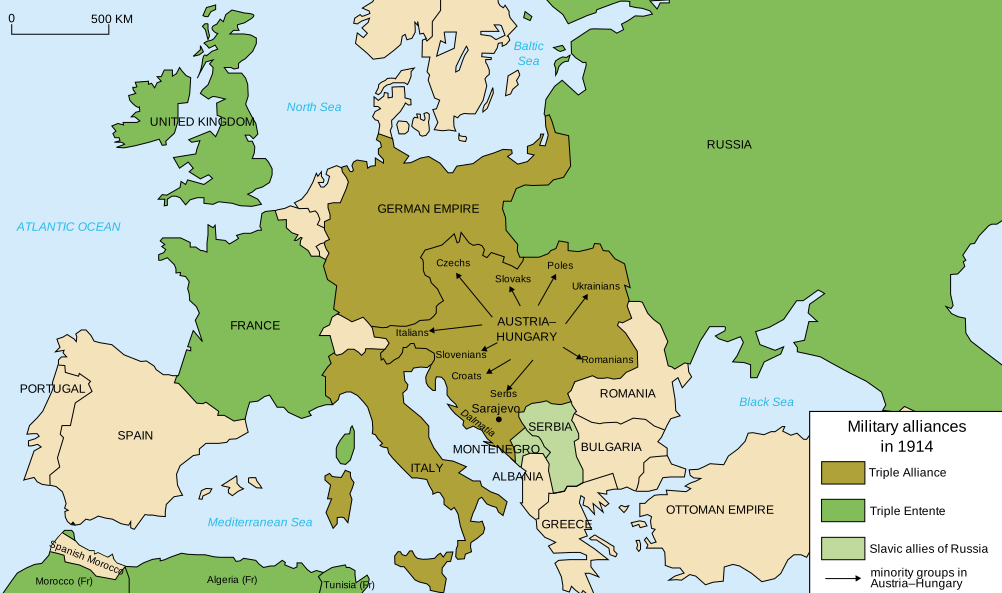
The Geopolitical Fault Lines of 1914 Europe
As shown in the alliance map above, Europe was split into two rigid blocks:
- The Triple Alliance: Germany, Austria-Hungary, and Italy.
- The Triple Entente: France, Russia, and Great Britain.
This defensive web was designed to maintain a balance of power. Ironically, it did the exact opposite. It ensured that local friction could no longer be contained.
2. The First Domino: The Sarajevo Spark
On June 28, 1914, Archduke Franz Ferdinand, heir to the Austro-Hungarian throne, was assassinated in Sarajevo by Gavrilo Princip, a Serbian nationalist.
Austria-Hungary saw this as the perfect excuse to crush its troublesome neighbor, Serbia. However, knowing that Serbia was backed by Russia, the Austro-Hungarians hesitated. They needed a guarantee. On July 5, Germany handed Austria-Hungary the infamous "Blank Check"—a promise of unconditional military support. With Germany's backing secured, the first domino was pushed.
3. The July Crisis: The Chain Reaction in Motion
What followed was a diplomatic breakdown of catastrophic proportions, known to history as the July Crisis. Military mobilization schedules acted as automatic triggers; once a nation began moving its troops, its rivals felt they had no choice but to do the same to avoid being caught unprepared.
- July 23 - The Ultimatum: Austria-Hungary delivers an intentionally unacceptable ultimatum to Serbia, demanding a complete surrender of Serbian sovereignty.
- July 28 - War Declared on Serbia: Despite Serbia accepting most terms, Austria-Hungary declares war and begins bombarding Belgrade.
- July 30 - Russian Mobilization: Russia, viewing itself as the protector of Slavic nations, orders full military mobilization to pressure Austria-Hungary.
- August 1 - Germany Intervenes: Viewing Russian mobilization as a direct threat, Germany declares war on Russia and demands France declare its neutrality. France refuses.
- August 3-4 - The Schlieffen Plan & Britain's Entry: To defeat France quickly, Germany invades neutral Belgium. This violation of international law forces Great Britain to declare war on Germany.
4. Mapping the Network: Who Triggered Whom?
To understand how quickly the system collapsed, we can look at the entry triggers for each major power during those fateful weeks:
| Nation | Alliance Alignment | Core Reason for Entry | Date of Entry |
|---|---|---|---|
| Austria-Hungary | Triple Alliance | Retaliation for the Sarajevo assassination; desire to crush Serbian nationalism. | July 28, 1914 |
| Russia | Triple Entente / Slavic Ally | Dynamic defense of Serbia and preservation of Balkan influence. | July 30, 1914 (Mobilization) |
| Germany | Triple Alliance | Honoring the "Blank Check" to Austria; fear of encirclement by Russia and France. | August 1, 1914 |
| France | Triple Entente | Bound by treaty to support Russia; desire to reclaim lost territories like Alsace-Lorraine. | August 3, 1914 |
| Great Britain | Triple Entente | Legal obligation to defend Belgian neutrality (1839 Treaty of London). | August 4, 1914 |
Historical Takeaway: The tragedy of World War 1 is that none of the European powers actively sought a global conflict that would claim over 20 million lives. Yet, because their diplomatic agreements and military plans were completely inflexible, they became prisoners of their own systems. The domino effect proved that when nations prioritize rigid military alliances over active diplomatic flexibility, peace becomes nothing more than a fragile illusion.
Post a Comment